
2014-06-15
Units
I have now finally added the possibility to specify units of attributes in HomeItems. This has been a request from users for some time. The units are shown on the Plan-page, the Room-page and in Item details as below:
This makes the values easier to read and understand. The feature is available in the nightly build.


Linux Serial Port
I got reports from several users that communication via the serial port to Tellstick stopped working when they upgraded their Linux installations. They saw the errors:
[ 146.590245] ftdi_sio: unknown parameter 'vendor' ignored
[ 146.590254] ftdi_sio: unknown parameter 'product' ignored
The problem proved to be that in kernel 3.12 the old interface to add custom VID/PID to the ftdi_sio drivers was removed (see commit link).
I have now made new installation scripts using the new official interface, and the installation page on the opennethome site is updated. The new scripts are also in the nightly build.
[ 146.590245] ftdi_sio: unknown parameter 'vendor' ignored
[ 146.590254] ftdi_sio: unknown parameter 'product' ignored
The problem proved to be that in kernel 3.12 the old interface to add custom VID/PID to the ftdi_sio drivers was removed (see commit link).
I have now made new installation scripts using the new official interface, and the installation page on the opennethome site is updated. The new scripts are also in the nightly build.
2014-06-07
Power Meter
OpenNetHome now finally has support for a Power Meter that can measure electricity consumption. The new FooGadgetPulse-Item supports the FooGadget Wireless Pulse Counter from FooGadgets, which can be connected to the standard blinking power meters often used in apartments and houses.
 The Item presents the current consumption in kW (average over 1 minute), how much energy has been used so far today in kWh, how much energy has been used so far current week in kWh and the total consumption so far. It also shows the total consumption for yesterday and last week.
It uses the latest version of the FooGadget protocol where it can lose hundreds of the transmissions from the sensor and still get the total consumption right. This is useful when you upgrade the server for example, even if the OpenNetHome is down for a while, the measurements of the energy consumption will still be correct for that period. The old protocol is also supported by the Item FooGadgetLegacy.
The FooGadgetPulse-Item can show a graph of the consumption over time. The graph shows the consumption in kW sampled and averaged over 15 minute periods:

I have also added a new Item called ValueLogger, which can log any attribute value of an Item and present the value as a graph.This is very useful in combination with FooGadgetPulse. You can for example put a log on the EnergyToday-attribute. This will present a graph over the total consumption for each day, and also show how the consumption was distributed over the day:

Both FooGadgetPulse and ValueLogger are available in the nightly build.
It uses the latest version of the FooGadget protocol where it can lose hundreds of the transmissions from the sensor and still get the total consumption right. This is useful when you upgrade the server for example, even if the OpenNetHome is down for a while, the measurements of the energy consumption will still be correct for that period. The old protocol is also supported by the Item FooGadgetLegacy.
The FooGadgetPulse-Item can show a graph of the consumption over time. The graph shows the consumption in kW sampled and averaged over 15 minute periods:
Both FooGadgetPulse and ValueLogger are available in the nightly build.
2014-06-01
FooGadgets
I got a tip from a NetHome user about a really interesting site called FooGadgets which sells wireless sensors using standard wireless thermometer protocols. You can for example connect 16 1-wire thermometer sensors to one sensor-card and they will show up as 16 separate thermometers in NetHome.
They also build a wireless pulse counter which can be attached to "blinking" energy meters so you can get data about your energy consumption. I am currently working on a HomeItem for the Wireless Pulse Counter, which will be able to presents graphs and values over the energy consumption in a house.
They also build a wireless pulse counter which can be attached to "blinking" energy meters so you can get data about your energy consumption. I am currently working on a HomeItem for the Wireless Pulse Counter, which will be able to presents graphs and values over the energy consumption in a house.
2014-05-04
Fine Offset Rain Gauge
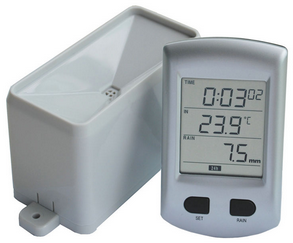
Unfortunately, the Tellstick does not currently support this sensor, so it will only work if you use the audio interface with OpenNetHome.
It is available in the nightly build.
2014-05-01
Fine Offset

Support for
the FineOffset protocol for
temperature and humidity sensors is now added to OpenNetHome. As usual, the
brand names of the products vary between countries, and in Sweden for example
they are sold under the name “Viking”. The usage in NetHomeServer is similar to
the Oregon Scientific, so there are two new HomeItems: FineOffsetThermometer and
FineOffsetHygrometer. As with the Oregon sensor, auto discovery is supported in
OpenNetHome, so if there are sensors in range, they will automatically be
presented on the Create/Edit-page. Note that not all FineOffset-sensors
actually have a humidity sensor included. Graphing of values is of course
supported as for the other sensors. Implementation is available in the nightly
build.
I am also working on support for the FineOffset Rain Gauge, but that is not finished yet.
2014-04-06
Oregon Scientific

As usual I cannot test all variants. I have tested with the THGN132N which is a thermometer/humidity sensor. I have however added code for the THGR122NX, THGN123N, THGR810 and THGR810 temp/hum sensors, the THN132N, THR238NF and THWR800 temp only sensors, the WGR800 wind sensor, the RGR968 rain sensor and the BTHR968 temp/hum/pressure sensor. The support for those is a bit more theoretical, I have implemented it according to specifications, but have not tested them. Oregon Scientific also have three versions of the protocol: 1.0, 2.1 and 3.0. I have now implemented the 2.1 version. 3.0 would be possible to add, but again I don't have any sensors so, that would be a bit too theoretical implementation and I don't know how commonly used it is. Implementation is available in the nightly build.
Subscribe to:
Posts (Atom)